

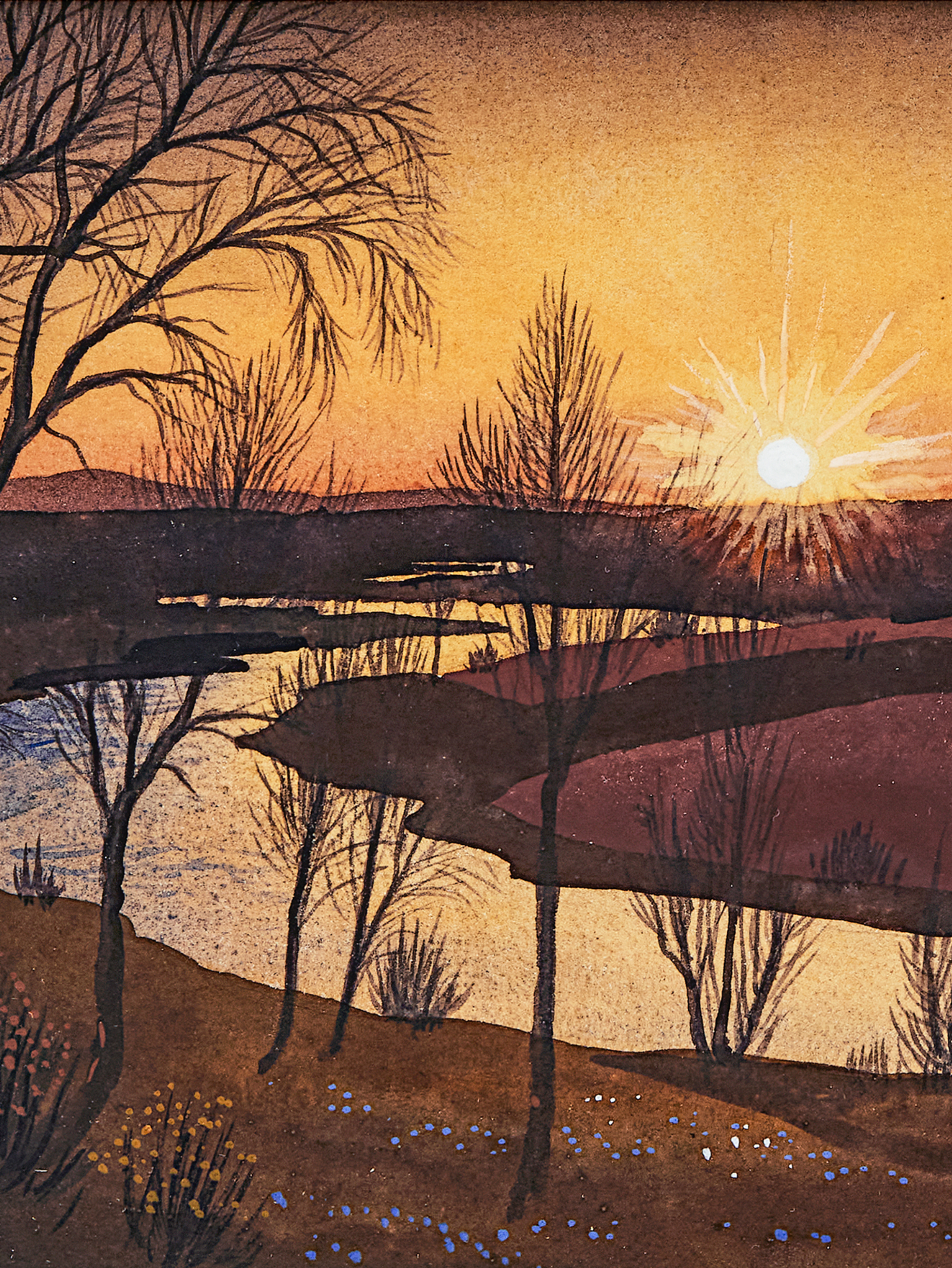
The Lagan from Laholm
Oskar Bergman was born in Stockholm in 1879 into a rather modest family. At home, no one noticed his aptitude for drawing and so the young boy taught himself what he could, occasionally receiving a few drawing lessons from a friend of his mother. The sudden death of his father in 1888 left the family in a difficult financial situation, and Bergman was already working as a courier for a tailor at the age of 13. During the week, he made deliveries in the streets of Stockholm, but every Sunday he visited the National Museum, where he was particularly attracted by Swedish Romantic painters such as Marcus Larson (1825-1864) and Nils Blommér (1816-1853). It was in this way that he forged a personal knowledge of art history. At the age of 16, he enrolled at the Technical School and studied under Anders Forsberg (1871-1914). Not dreaming of continuing his studies at the Academy, he decided, with his small savings, to travel around Europe discovering museums and collections. In 1901, he went to Germany, where, in addition to the Old Masters, he discovered the art of Caspar David Friedrich. Bergman was fascinated by the German painter’s works, in which nature was freed from the frenzy of Romantic art.
His return to Sweden was marked by his meeting with the banker Ernest Thiel (1859-1947), a great patron of the Swedish art scene, who encouraged him by buying him a drawing for 30 francs. The relationship with the banker continued and Bergman was invited to his artists’ residence in Saltsjöbaden. In 1904, through the intermediary of Thiel and his wife, he met the Symbolist artist Armand Point, who was so impressed by Bergman’s talent that he advised him to join him in Florence to follow his courses. Thiel financed the trip to Italy and Bergman took the opportunity to visit Berlin, Munich, Verona and Rome. On arriving in Florence, he showed Point the drawings and notes he had made during the trip and the painter agrees to give him free lessons. His years as an apprentice at Point were marked by the discovery of Arnold Böcklin, whose influence was very strong in the works of the first decade of the twentieth century and would later diminish, though never completely disappear, over time.
Returning to his homeland in 1906, he organized an exhibition with the sculptor Peter David Edstrom (1873-1938) and the painter Ivar Arosenius (1878-1909), which was the first real showcase for our artist. In 1909, the Swedish art scene was rocked by the scandal of the modernist group “The 1909 Men”, which introduced the revolutions of the Expressionist/Fauvist avant-garde to the country. Here, Bergman’s placid landscapes appeared to critics and the public as examples of traditional Swedish painting. This was the start of a flourishing period in the artist’s career, and he took part in various national and international exhibitions. In 1917, the National Museum in Stockholm bought the watercolor By the Sea. This success came to an end in 1930, when painters such as those in “Men 1909” were no longer scandalizing, but were beginning to appeal to a more cultivated public. Bergman did not, however, allow himself to be tempted by the trends and the new expressive freedoms, but continued his research. Every day, after a walk in nature, he locked himself in his studio where he worked on two watercolors at the same time. His tenacity and his testimony to the Swedish landscape made him such a national artist that in 1957 he was awarded the Egron Lunagren medal by King Gustav VI Adolphe. When Oskar Bergman died in 1963 at the age of 84, he was one of the country’s most celebrated artists.


