

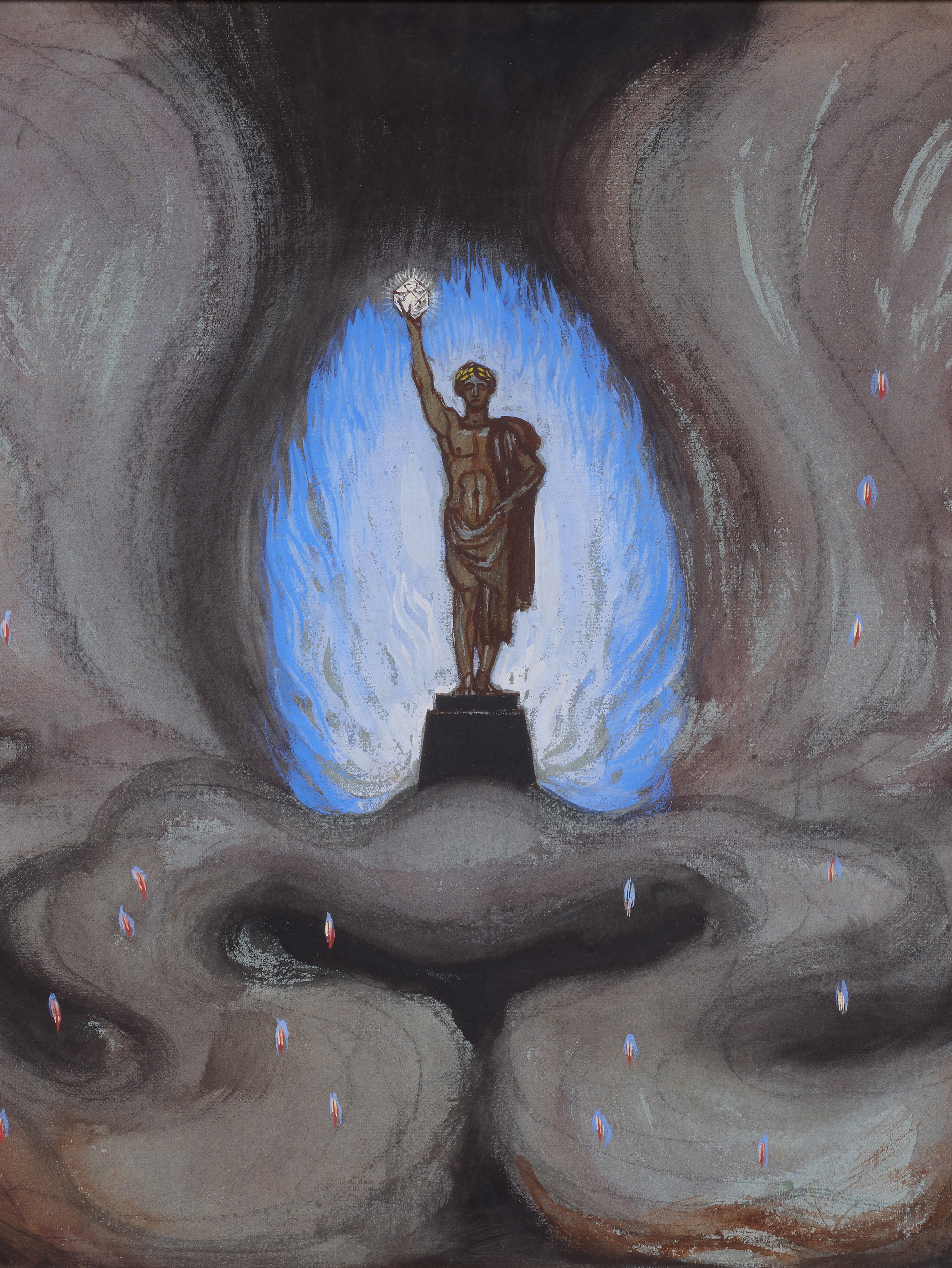
The Philosopher’s stone
Painted in 1896, The Philosopher’s Stone belongs to the crucial moment in which Franz von Stuck affirmed himself as a central figure of the Munich Secession and gained recognition beyond Germany. After the success of The Guardian of Paradise of 1889 and, even more decisively, the iconic Sin of 1893, in which Eve confronts the viewer with a serpent coiled around her neck, Stuck became a leading presence in Munich. In the mid 1890s he was at the height of his creative force, producing some of the most powerful and enduring images of his career.
This composition, whose whereabouts had long been unknown, was recorded in H. Voss’s 1973 catalogue raisonné under the uncertain title “Guardian”. Voss knew it only through a photograph preserved in the archives in Berlin. That photograph came from the 1908 auction catalogue of the collection of Max Klopfer and Theodor Klopfer (fig.1), who owned, in addition to this sheet, several works from Stuck’s production of the 1890s, including a version of the celebrated Die Sünde. Thanks to this document, the subject can be securely identified as The Philosopher’s Stone. The image is immediate and commanding. A classical figure crowned with laurel rises above a pedestal, surrounded by incandescent vapours from which fire appears to descend. In her raised hand she displays a squared white stone, luminous like a supernatural diamond. Behind her, a blue flame isolates the figure from the dark ground and intensifies her presence. The handling of the body and the monumentality of the pose are fully consistent with Stuck’s works of 1894 to 1896.
The dramatic intensity of the scene recalls Wagnerian imagery, especially Siegfried, in which the hero must pass through a circle of supernatural fire that only the worthy can cross unharmed. Fire functions here as purification and transformation. It destroys what is old, clears the way, and signifies rebirth. Stuck does not present the theme in the traditional manner of the alchemist absorbed in laboratory experiments. Instead, the stone appears as an achieved goal, a visible sign of spiritual conquest.
By rendering the Philosopher’s Stone as a white, diamond like block, Stuck also evokes the radiant treasures of Germanic myth, such as the hoard of the Nibelungen and the Rheingold, often imagined as luminous substances charged with spiritual power. The brilliance is detached from material realism and suggests a light of supernatural origin. The motif may also resonate with biblical symbolism. In the Book of Revelation (2:17), the white stone signifies divine election and absolution. In exegetical tradition it marks the culmination of an inner journey and the promise of regeneration. A meaningful iconographic parallel can be found in William Blake’s illustrations to the Apocalypse, where the Angel of Revelation (fig.2) stands immersed in flames and light. In both Blake and Stuck, the solitary body, isolated within an incandescent radiance, becomes the vehicle of an apparition poised between the human and the supernatural. Taken together, these elements form a distinctly Symbolist vision in which classical form, spiritual alchemy, Wagnerian theatre, and Germanic mythology converge. The Philosopher’s Stone is not presented as a scientific object, but as an image of transcendence, illumination, and inner transformation.


