

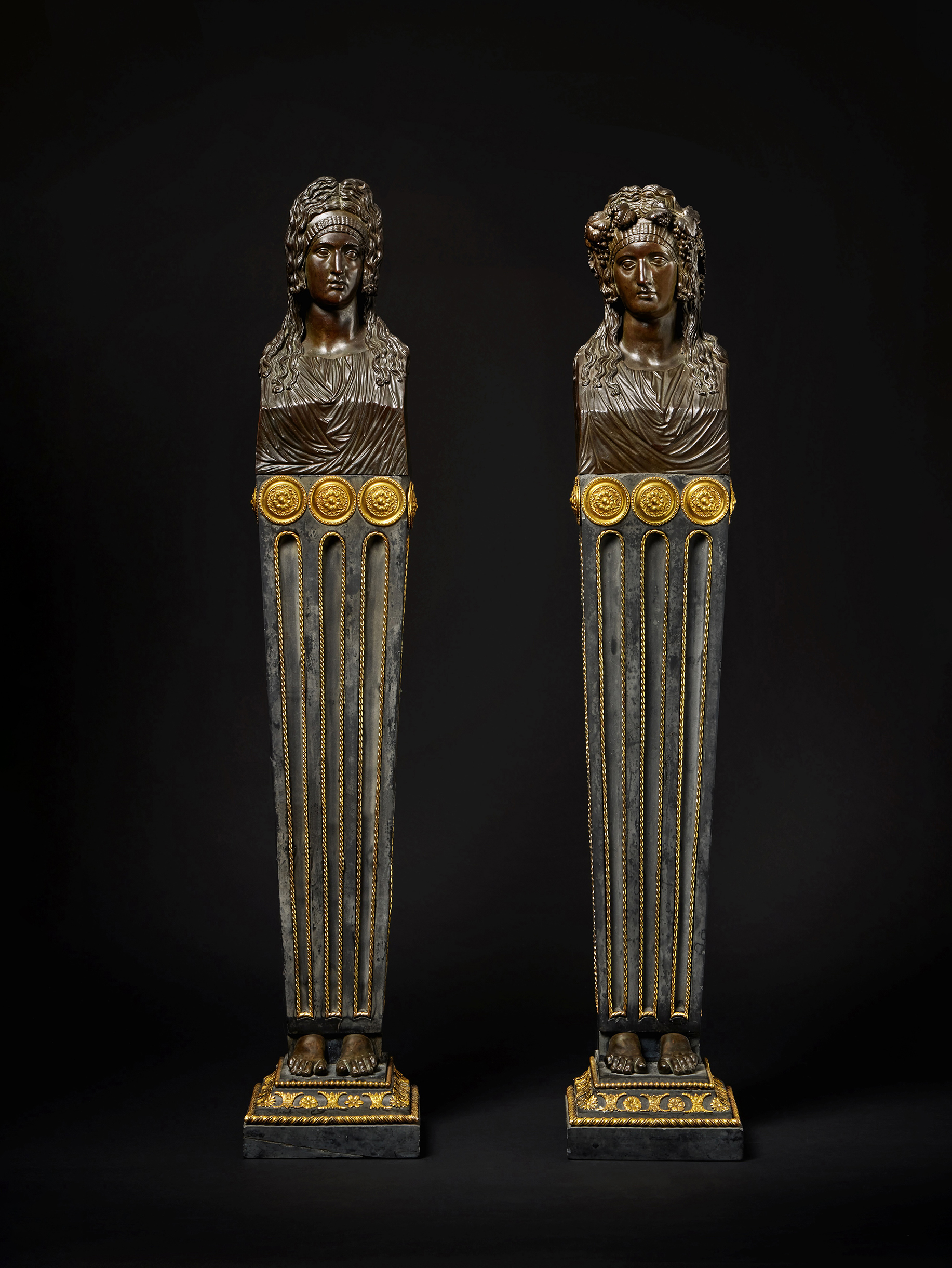
A pair of term columns of Thalia and Melpomene by Francesco Righetti (1749-1819)
Signed and dated in 1788, these exceptional bronzes by Francesco Righetti are unknown in any other casts and represent an early and highly glamorous example of the vogue for Grand Tour bronzes. They demonstrate that whilst many visitors to Rome were able to buy countless copies of the Apollo Belvedere, the Capitoline Venus, or the Discobolus, there also existed a higher level of ‘souvenirs’ that were made for the most exclusive clients.
These exceptional busts appear to be unique. They are copies of two famous antique herm busts representing Salonia Matidia in the guise of Melpomene, muse of Tragedy and Salonia Matidia in the guise of Thalia, muse of Comedy. Both busts are in the Sala Rotonda in the Vatican’s Museo Pio-Clementino (inv. 262 and 285). The marble busts were reputedly found in 1735 by Giuseppe Fede at Hadrian’s Villa near the entrance to the Greek theater. Restored by Bartolomeo Cavaceppi, the busts were acquired in 1777 for the Vatican collections. By the time Righetti made his bronze reductions a decade later, the busts would have been recognizable as among the masterpieces of the Vatican. The busts stand on plain marble pedestals which continue the herm shape of the busts, but Righetti has enhanced their impact as reduced bronzes by the addition of fluted marble pedestals with human feet at the bottom cast in bronze. Displayed on a console or tabletop, the combination of Righetti’s bronzes with the elaborate pedestals create a luxurious impression befitting the theatrical subject matter and the quality of the craftsmanship.


&description=A pair of term columns of Thalia and Melpomene by Francesco Righetti (1749-1819))
