

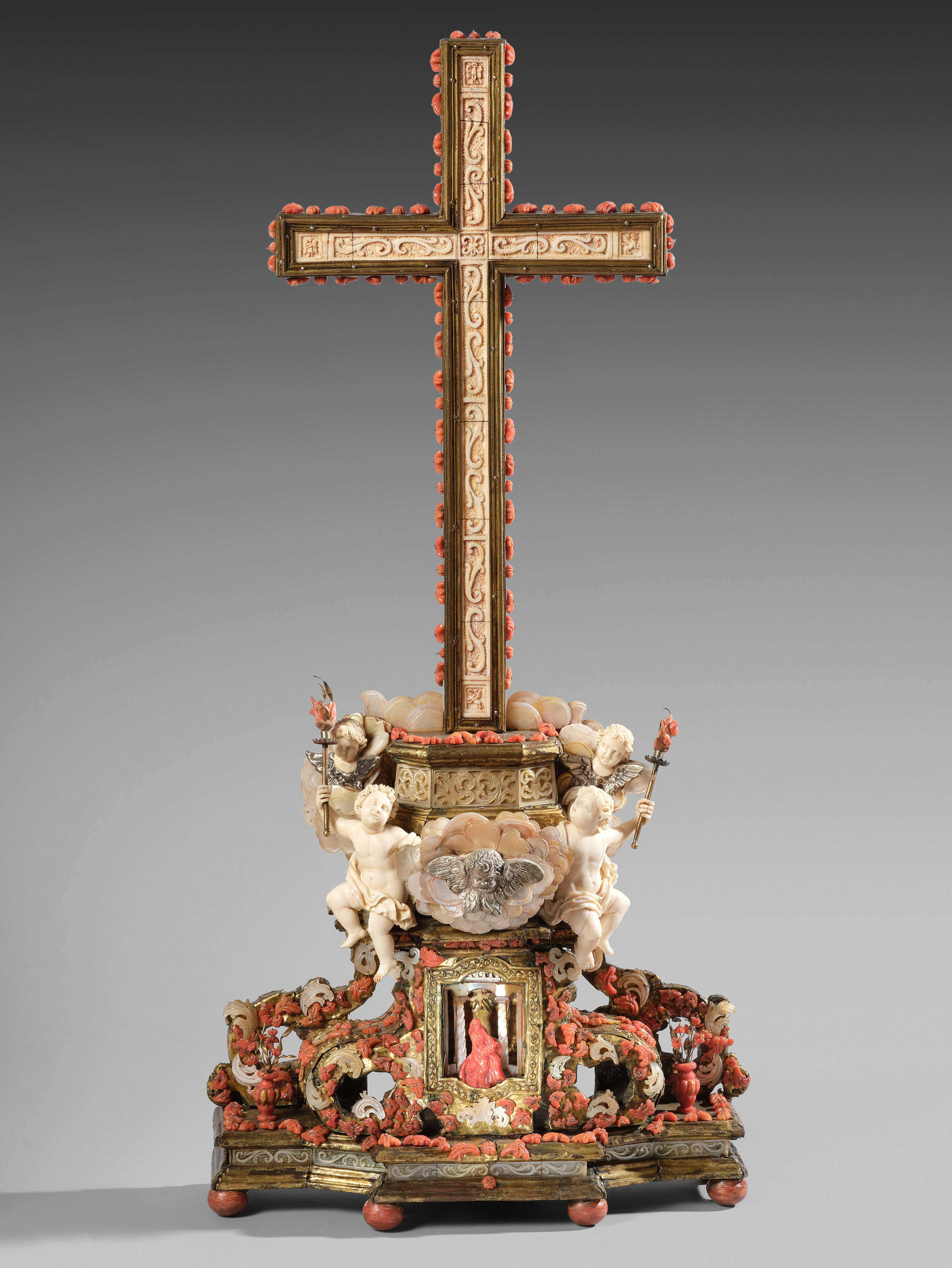
Cross attributed to Andrea Tipa (1725-1766)
Sicilian works of art, particularly from Trapani, embody knowledge, refinement, courage, and human ingenuity. This crucifix, dated to the first half of the 18th century and attributed to Andrea Tipa on stylistic grounds, reflects the combined skills of artisans, sculptors, chasers, fishermen, seafarers, and engravers, resulting in a unique creation.
Our piece belongs to the late flourishing of Sicilian coral craftsmanship from Trapani: a culminating moment when artists and artisans reached technical perfection, joyfully combining and blending heterogeneous, noble, rare, and precious materials into a harmonious and richly balanced whole. Rising from a pedestal still marked by Baroque taste stands a splendid cross in bone, carved with a delicate arabesque motif that ends at its four extremities with the symbols of the Evangelists. Around the cross, a gilded copper plaque frames the entire perimeter and is adorned with small coral fragments worked into acanthus leaves.
At the foot of the cross, clouds carved in mother-of-pearl reveal the apparition of two ivory cherub heads with silver wings. Beneath this mystical vision, two small ivory angels appear, one on each side, holding torches whose flames are rendered in coral. Between them, a final mother-of-pearl cloud shelters, at its center, a cherub head with silver wings. Following the volutes downward, one reaches the base, where a triumph of acanthus leaves in coral and mother-of-pearl adorns the entire surface. At the center, within a mother-of-pearl niche, stands a small coral statue of the Virgin receiving the visit of the Holy Spirit in the form of a dove carved in mother-of-pearl. When the niche is illuminated, it shines brilliantly, revealing the artisan’s meticulous care, even in the smallest details, with the insertion of a tiny architecture of columns and balustrade within this central space. On the exterior, at each side, two vases hold flowers—symbols of sanctifying grace—once again rendered entirely in coral.
This profusion of precious materials, masterfully worked, is typical of 18th-century production from Trapani. The decorative motifs of these miniature architectures often find their origin in those of Sicilian churches and palaces. Sicily, thanks to its strategic position in the Mediterranean, has always been a crossroads where cultures and peoples from afar met, bringing with them techniques, materials, skills, artistic motifs, and diverse tastes. An object such as this thus seems to encapsulate within itself the entire history of Mediterranean peoples.
Our cross is rich in Christian symbolism, narrating the story of salvation—from the Annunciation to the sacrifice of the Cross. Coral reinforces this symbolism: historically a talisman against evil and disease, in Christianity its red hue became the Divine Blood and a symbol of the soul’s salvation.
The two small ivory angels and cherub heads show a clear affinity with the work of Sicilian sculptor Andrea Tipa (1725–1766), son of Giuseppe and brother of Alberto. Their family specialized in combining ivory with coral, shell, wood, and gilded copper. The detailed facial features, modeling, and technical mastery confirm this attribution.
A precious material sought after by peoples across the world, coral was long considered a natural wonder. The artisans of Trapani transformed it into an artistic marvel, mastering a material notoriously difficult to work. Trapani coral was renowned as the finest and most valuable, and the local artisans were among the most skilled in this craft. They descended from ancient Jewish families who had emigrated from North Africa in the 9th century, fleeing famine and epidemics. Upon arriving in Sicily, they enjoyed a relative degree of religious tolerance under the Arab, Norman, and Swabian dominations, until Spanish rule. From the 14th century onward, they began producing paternostri, or coral rosaries, gradually perfecting their craft and reaching their peak in the 17th and 18th centuries. After the expulsion of the Jews from Spain in 1492, decreed by the Catholic monarchs, many resisted by converting to Christianity and continuing their work. Each Trapanese object thus also tells a story of skill and courage: that of the fishermen who braved the sea and the pirates who infested the Mediterranean to gather, from its depths, these blood-red branches—the source of a unique and astonishing production. Today, coral objects from Trapani are extremely rare and highly sought after, and can be found in the collections of the world’s leading museums, including the Metropolitan Museum of Art in New York and the Museo Nazionale di Napoli.


&description=Cross attributed to Andrea Tipa (1725-1766))
