

Parfums sacrés
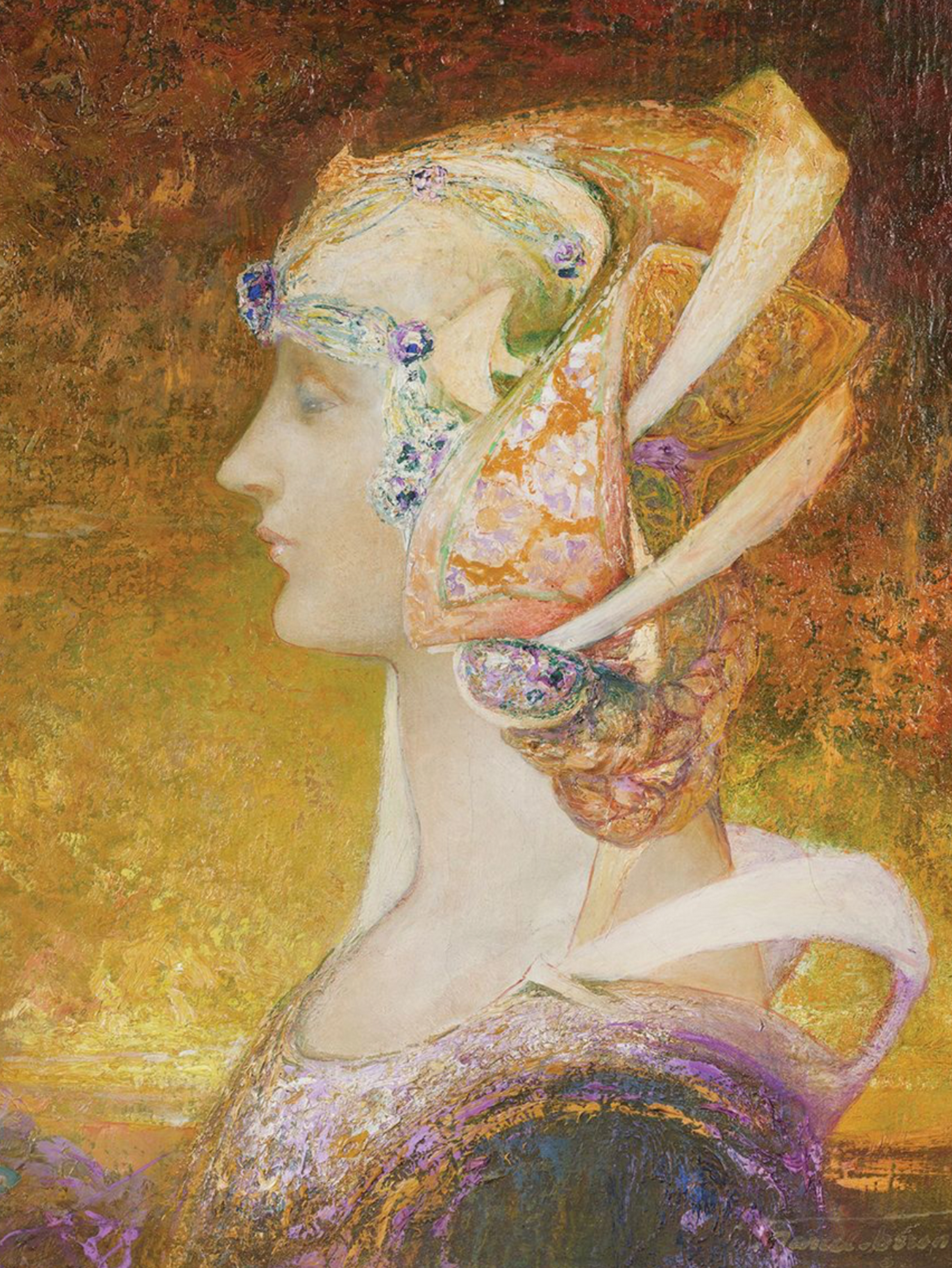
In 1903, the Belgian writer Hector Fleischmann was strolling through the streets of Paris when, upon reaching rue Bonaparte, he paused before the window of a painting dealer. What caught his attention were two works by Pierre Amédée Marcel Béronneau. One of them, titled Parfums sacrés, depicted a fatal woman in profile, richly adorned with jewels, extending before her a censer from which perfumed vapours gently rise. Though brief, Fleischmann’s description seems to correspond closely to our painting. Concluding his evocation, he remarked: “This painting reveals in its author a superior temperament of a visionary.”
“Visionary” is indeed one of the adjectives that best characterises Béronneau and his oeuvre, in which the figure of the femme fatale occupies a central and recurring role, often embodied in a Salome draped in diadems and orientalising garments. Drawn to sumptuous art, distant myths and religious themes, as well as to fantastic and exotic atmospheres, Béronneau stands among the notable interpreters of French Symbolism and ranks as one of the most prominent pupils of Gustave Moreau (1826-1898). Parfums sacrés reveals both Moreau’s influence and Béronneau’s independence. While the precious handling of paint, composed of minute touches that define the intricate structure of the woman’s headdress with jeweller-like precision, recalls Moreau’s manner, the violet and rose hues, the indeterminate background and the treatment of volumes are distinctly Béronneau’s own. The profile evokes Italian Quattrocento portraiture, particularly that of Piero del Pollaiolo. Medievalising atmospheres and the fascination with early Italian painting were characteristic of French Symbolism, which projected onto that distant era a sense of mystery and poetic allure absent from modern society. At the same time, the censer’s Art Nouveau form calls to mind the ceramics produced in southern France by Clément Massier (1845-1917).
Born in Bordeaux in 1869, Pierre Amédée Marcel Béronneau began his artistic training at the École municipale des Beaux Arts of his native city. In 1890 he moved to Paris and, two years later, enrolled at the École Nationale des Arts Décoratifs. These were decisive years for French culture. For nearly a decade, Symbolism had been steadily gaining ground among the intelligentsia, offering an aesthetic alternative to the perceived triviality of modern life. After an initial period of study with Eugène Thirion (1839 to 1910), Béronneau entered the studio of Gustave Moreau, a central figure of Symbolist painting. The young artist quickly gained his master’s esteem by combining academic discipline with a refined interest in fifteenth century Italian art. Moreau’s influence, clearly visible in Béronneau’s precious surfaces and mythological imagination, became a defining element of his style, yet he reinterpreted it with a greater solidity of form and a more pronounced volumetric presence.
Béronneau made his debut at the Salon des Artistes Français in 1895. Two years later, in 1897, he participated in the final Salon de la Rose+Croix organised by Joséphin Péladan (1858 to 1918), writer, critic and occultist, who promoted a revival of spiritual and idealist art. On this occasion, Béronneau exhibited Orpheus, one of his most ambitious compositions, representing the descent of the Thracian hero into the underworld and demonstrating his aptitude for complex mythological subjects. By the turn of the century, Béronneau had established himself among the noteworthy representatives of French Symbolism. His refined technique, his taste for sumptuous detail and his evocative treatment of myth and legend contributed to the distinctive character of his work. Today, his paintings are preserved in several French public collections, including the Musée du Louvre, the Musée des Beaux Arts de Bordeaux and the Musée des Beaux Arts de Marseille, confirming the lasting appreciation of his contribution to Symbolist painting.


