

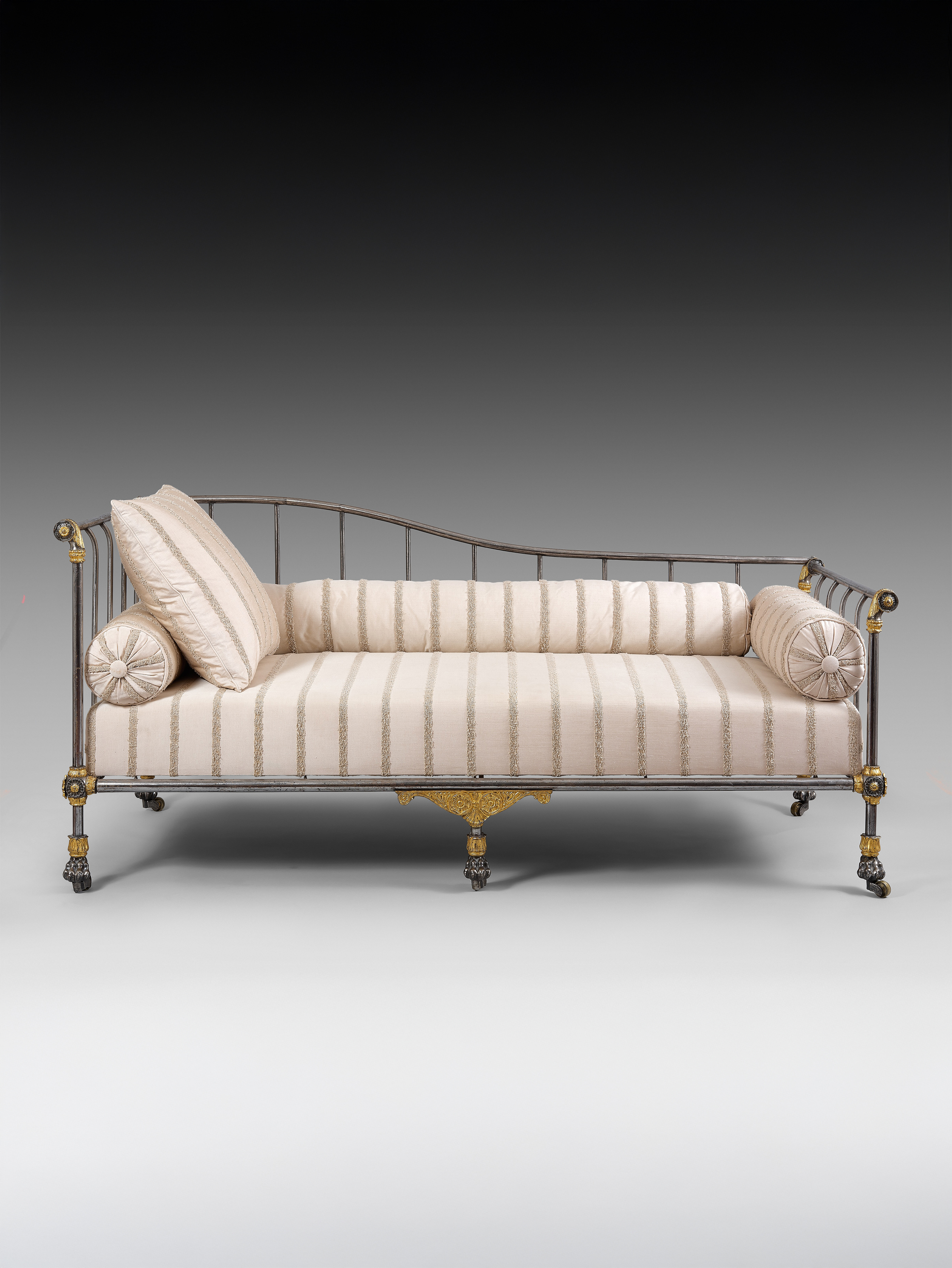
Steel meridian
The meridian, which can be completely dismantled, has a polished steel tubular frame with two footboards of different heights, openwork with four vertical rods, flanked by two uprights of larger diameter, each topped with a cylindrical finial in the shape of a crook, engraved with golden motifs of rosettes, palmettes, pearls, and heart stripes.
Perpendicular to the legs, a “lattice” backrest features an upper ogee crossbar, the ends of which are shaped like legs and screwed onto the crooks described above. Those of the lower crossbar are set and screwed into finials embellished with stylized, gilded heart-shaped corollas.
The longitudinal crossbar of the bed, positioned at the front, is highlighted in the center by a gilded “lamp base,” richly decorated with rosettes, palmettes, and festoons, all supported by a tubular leg ending in claws and mounted on casters, identical to the four main legs of the chaise longue.
While the predominantly plant-based decoration of this ensemble is more in keeping with the decorative repertoire used during the Restoration, the claw-foot bases still belong to the style that was in vogue during the Empire.
* * *
The appeal of polished steel and iron furniture reached its peak in France during the Revolution, the Consulate, the Empire, and the Restoration. The quality of the materials used, but above all the prevailing taste of the time for martial furniture—a genuine reaction to the forms of expression of the Ancien Régime—contributed greatly to the success of metal furniture, whose merits were repeatedly recognized at various exhibitions of French industrial products, which began in 1798.
No fewer than seven specialized manufacturers were listed in the 1812 Almanach du Commerce, including the metal varnish manufacturer on Rue Martel; Blaise-Louis Deharme (a dissident from the former), located on Rue du Faubourg-Saint-Denis; Hautin, on Rue Grange-Batelière; Lehoux, on Rue du Maine; Jolly, on Rue des Fossés-Saint-Germain-l’Auxerrois; and Boulanger, at 144 Rue du Faubourg-Saint-Denis, whose business continued until the July Monarchy (1830-1848). In France, most of this production remained concentrated in Paris.


